
Around how much does it typically cost to create, stock, and maintain a private wine cellar?
For the discerning property developer, architect, or luxury homeowner, a private wine cellar is far more than a storage area—it’s a statement of sophistication and an investment in lifestyle. When planning this dedicated space, the first and most critical question is always: around how much does it typically cost to create, stock, and maintain a private wine cellar? The answer is not a single number but a spectrum that ranges dramatically based on your choice between standardized wine racking kits and a fully bespoke architectural installation. At Ciematic, we understand that true value lies in the details. Let’s dissect the true investment required, moving beyond generic price tags to understand value, long-term performance, and design integrity.
Understanding the Cost Spectrum: Kit vs. Custom
The fundamental cost variance lies in the approach. Off-the-shelf wine rack kits and plug-in wine coolers refrigerators are mass-manufactured, immediate solutions. Conversely, a custom or bespoke wine cellar is a meticulously engineered environment. For high-end residential or commercial projects, the decision has significant implications for property value, spatial efficiency, and the actual preservation of the wine. A generic rack might hold bottles, but a Ciematic-designed cellar preserves assets.
The True Cost of “Ready-Made” Systems
On the surface, a modular wall mounted wine rack system appears cost-effective. For a small collection of 50 to 100 bottles, you might find wooden wine rack kits or basic metal wine rack units ranging from $500 to $3,000. However, these rarely factor in the essential life-support of a collection: climate control. Adding a self-contained wine cellar cooling unit to a standard room often creates humidity imbalances, leading to dried corks or label mold. For a developer, specifying these low-tier products often results in a finished space that lacks the aspirational quality expected in luxury estates, failing to provide a genuine long-term storage environment.
The Investment Logic of a Bespoke Wine Cellar
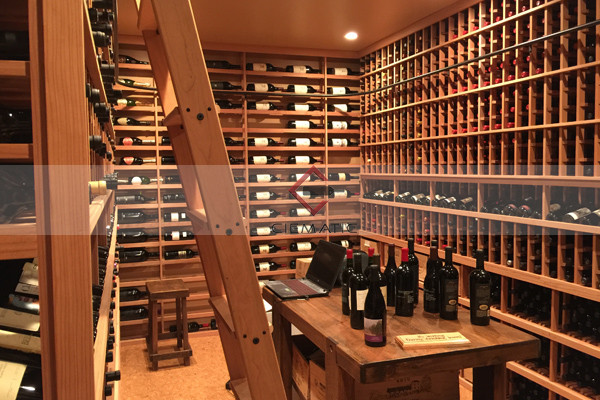
Stepping into the realm of a bespoke, custom wine cellar shifts the conversation from mere expense to capital investment. Here, the cost per square foot begins where kits end. For a connoisseur or a landmark commercial venue, a fully conditioned cellar designed by Ciematic involves architectural planning, specialized climate analysis, and material curation. Whether you envision a dramatic modern wine cellar with frameless glass or a stately classic wine cellar with rich mahogany, the cost—typically starting at $25,000 and exceeding $100,000+ for extensive builds—reflects a precision-controlled ecosystem. This is essential for safeguarding valuable vintages and wine for cellaring that appreciates over decades.
Breaking Down the Core Cost Drivers
To budget accurately, one must look beyond the racks themselves. A sophisticated wine cellar functions as a cohesive system. Three primary components dictate the final investment: cabinetry, climate control, and spatial architecture. Ciematic approaches each of these with a meticulous engineering mindset.
1. Racking and Cabinetry: Beyond Basic Storage
This is the visual focal point. While mass-market wine racks for sale offer generic wood or chrome wire, a professional project demands durability and custom geometry. Clients often require solutions for challenging architectural footprints, such as under-stair wine cellars or curved wine cellars. These custom configurations, a Ciematic specialty, utilize every cubic inch. Furthermore, the integration of a wine glass rack, a wine cabinet bar, or tasting tables elevates the room into a functional entertainment space. A premium wine cabinet wall mounted system not only displays bottles optimally but also incorporates the wine glass holder solutions that automated kits lack.
2. Climate Control: The Invisible Engineering
This is the single most common point of failure in poorly planned cellars. True wine cellar cooling systems differ entirely from standard wine coolers for sale. They manage temperature and maintain 55-70% humidity to keep corks swollen and labels pristine. A ducted split system, which Ciematic often integrates seamlessly into the design, represents a higher upfront cost but is non-negotiable for proper cellaring. For architects, specifying a professional cellar cooling unit ensures the cellar operates efficiently without dumping hot air into adjacent living spaces, a critical consideration in open-plan high-end homes.
3. Construction and Insulation: Sealing the Envelope
A genuine home wine cellar requires a vapor-sealed envelope. This involves exterior-grade insulation, vapor barriers on the warm side of the wall, and an insulated wine cellar doors unit. Neglecting this structural build-up in favor of simply placing a free standing wine rack in a spare room will doom the cooling unit to failure and the wine to premature aging. High-end cellars built by professional teams like Ciematic factor in these construction contingencies, ensuring the space performs as a true underground cellar even if located on a main living floor.
Stocking and Maintenance: The Long-Term Horizon
Once the cellar is built, the recurring costs begin. Stocking a collection is deeply personal; an investor might allocate $50,000 to blue-chip Bordeaux, while a budding enthusiast fills a tall wine rack with cases of $30 gems. The physical hardware for stocking, like specific wine bottle holder inserts or display niches, should be designed to accommodate large formats—a standard consideration in every Ciematic design. Long-term maintenance then focuses on the wine cellar cooling unit. Annual HVAC inspections, costing a few hundred dollars, are critical. Neglecting this can turn a beautiful wine storage cabinet environment into a disaster zone, destroying thousands in inventory.
Maximizing ROI in Commercial and Residential Design
For commercial developers and hospitality ventures, the type of cellar installed directly correlates with audience perception. A commercial wine cellar with a massive custom wine display signals authority and invites higher spend per head. In luxury residences, a dedicated wine cabinet or a sprawling wine wall becomes the architectural soul of the entertainment space. Unlike standard wine racking kits, a custom Ciematic space featuring wine barrel accents and architectural joinery can increase a property’s perceived value far beyond the construction cost. It transforms a basement corner into a selling point that resonates with high-net-worth buyers seeking a turn-key luxury lifestyle.
Conclusion: Cost vs. Legacy with Ciematic
Calculating the typical cost to create, stock, and maintain a private wine cellar ultimately depends on whether you view the project as a storage shelf or a legacy build. For the targeted reader—the luxury developer, the visionary architect, the private collector—the decision to move beyond cheap modular kits to a custom-engineered environment is a reflection of professional standards. A properly designed Ciematic cellar protects liquid assets while enhancing the architectural narrative of the property. To explore how a fully integrated, architecturally significant cellar can differentiate your next project, the Ciematic team is ready to consult and ensure that your vision of the perfect cellar for wine materializes not just beautifully, but impeccably functional for generations.